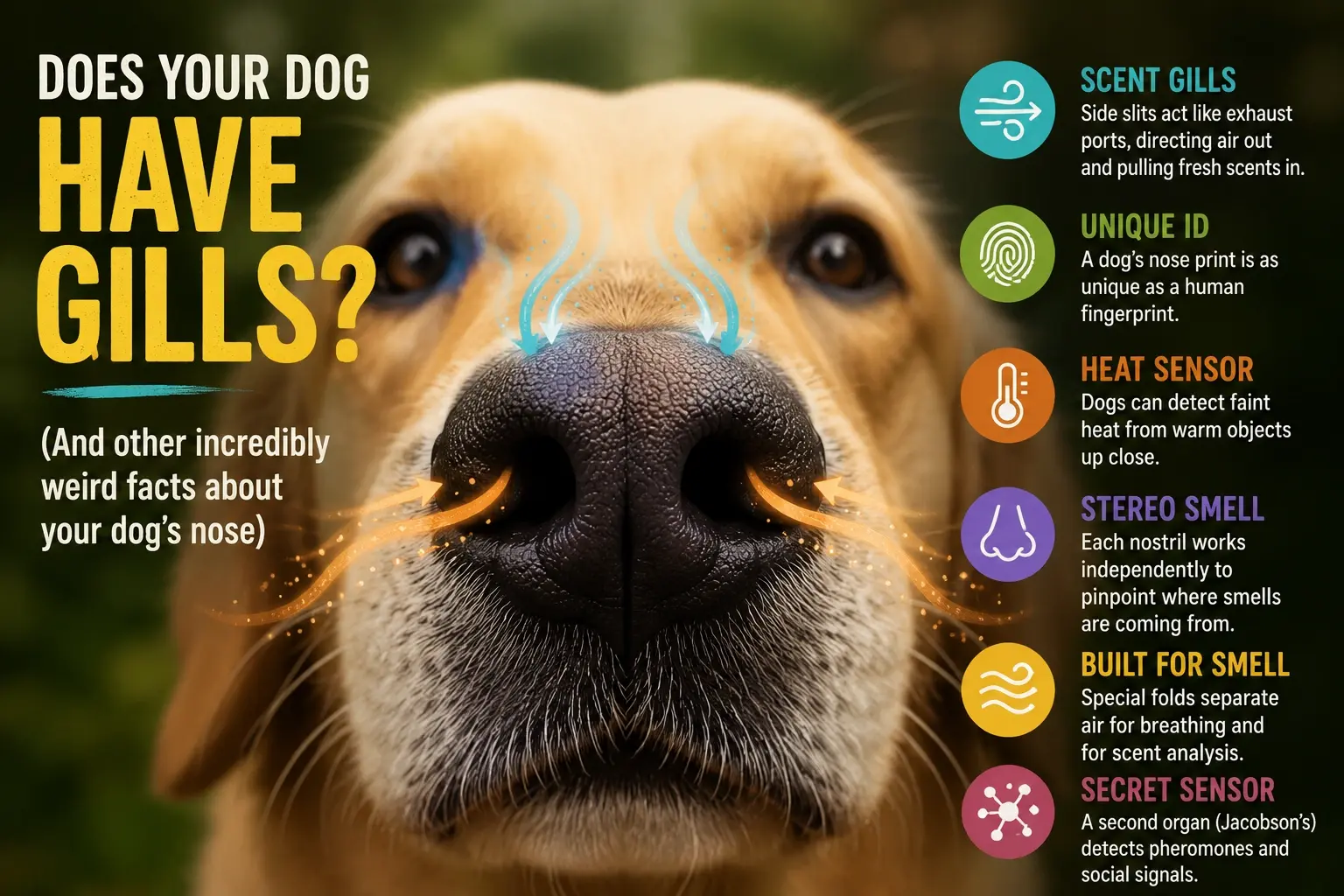
Does Your Dog Have Gills? (And Other Incredibly Weird Facts About Your Dog’s Nose)
Those slits on the sides of your dog’s nose.
You’ve seen them ten thousand times. You’ve probably booped them.
They’re not decorative.
They’re exhaust ports.
Does your dog have gills?
When your dog sniffs, air is drawn in through the front of the nostrils. When your dog exhales, much of that air is directed down and out through the slits along the sides of the nose.
That apparently tiny design choice does something remarkable: it keeps the outgoing breath from blasting straight ahead into whatever your dog is trying to smell.
But the engineering gets weirder.
Those downward-and-sideways puffs of exhaled air create turbulent little jets that can pull fresh, odor-filled air toward the nose. On the next sniff, your dog inhales some of that newly recruited scent.
Researchers studying dog-inspired artificial noses found that this pulsing sniff-exhale-sniff system dramatically increased how effectively a model nose collected odor molecules compared with simply sucking air inward continuously. Dogs can repeat this cycle around five times per second.
So your dog is not literally inhaling and exhaling at the exact same moment. The system is arguably stranger than that: every exhale helps prepare the air for the next inhale.
Your dog’s breath is running advance reconnaissance for your dog’s nose.
So—gills?
Technically, no.
Let’s call them scent gills.
And that is only the first item in the nose file.
1. Your dog’s nose has separate lanes for breathing and smelling
When you inhale, you probably think of air entering your nose and heading toward your lungs.
A dog’s nose is more complicated.
Its internal architecture helps divide incoming air into different flow paths. Most continues through the respiratory tract. Another portion is routed toward a specialized region packed with olfactory tissue, where odor molecules can be analyzed.
In other words, a dog does not simply breathe through its smell detector.
Its nose has built-in traffic management.
Studies of canine nasal airflow have found that roughly 12–13% of inspired airflow can be directed toward the olfactory region, while the rest continues along the respiratory pathway.
Imagine walking into a bakery and having your nose automatically send one stream of air to your lungs and another to a dedicated laboratory whose only job is answering:
Croissant? Cinnamon roll? Bagel? Which shelf? How recently baked?
That is closer to what your dog is working with.
2. A smell can hang around even after your dog exhales
Here is the detail that makes the whole “continuous smelling” idea even better.
Inside a dog’s nose is an olfactory recess—a specialized scent-analysis area tucked away from the main respiratory airflow.
During exhalation, that recess is not simply flushed clean the way you might expect. Researchers describe the arrangement as allowing inspired odor-bearing air to remain in contact with olfactory receptors even while the dog moves into the expiratory part of the breathing cycle.
So while your dog is technically alternating between inhaling and exhaling, its scent receptors can keep working on the sample.
The nose has essentially put the smell on hold.
This is why “dogs inhale and exhale at the same time” is not quite right—but the real explanation is arguably cooler.
They have a smell chamber that keeps analyzing while the plumbing switches direction.
3. Your dog smells in stereo
You hear in stereo because your brain receives slightly different information from your left and right ears.
Dogs can do something similar with smell.
Each nostril collects its own sample of the surrounding air. Those bilateral samples can help the dog work out where an odor is coming from.
That matters when the thing you’re hunting is invisible.
A smell may be stronger on one side. Its concentration may change as the dog moves. The plume itself may drift, break apart and reform with tiny movements of air.
Your dog’s brain is assembling those clues while the nose keeps sampling.
So when your dog suddenly veers three feet to the left during a walk and buries their face in a tuft of grass with the intensity of a detective discovering the key piece of evidence—
there may actually have been some triangulation involved.
You hear in stereo.
Your dog smells in it.
4. Your dog is wearing a biometric ID on their face
Look closely at the leathery surface of your dog’s nose—the rhinarium—and you’ll see a complicated landscape of grooves, ridges and tiny patterns.
Those patterns appear to be individually distinctive.
A 2021 study examined canine nose patterns visually and with biometric algorithms. Researchers tested hundreds of nose images representing dozens of dogs and found that the patterns could distinguish individual animals and remained stable across repeated images.
And humans figured out the potential surprisingly early.
Scientific literature on canine nose biometrics traces the Canadian Kennel Club’s use of nose prints for identification back to 1938.
So yes: long before Face ID, your dog was walking around with a biological identification pattern stamped directly onto the end of their face.
Your dog has papers.
They’re just attached to the booper.
5. That cold nose may actually detect heat
This one sounds made up.
It isn’t.
The hairless tip of a dog’s nose is often noticeably cooler than the surrounding environment. It is also richly supplied with nerves.
Researchers wondered whether that cold surface might be sensitive to something besides touch.
So they tested it.
In a 2020 study, dogs were trained to distinguish between an object at roughly room temperature and one giving off weak thermal radiation comparable to a warm mammal. In the behavioral experiment, the stimuli were presented about 24 centimeters—roughly 9½ inches—from the dogs’ noses.
The dogs could distinguish them.
A second part of the study used brain imaging in awake dogs and found increased neural activity in response to the warm stimulus.
So “heat vision” is overselling it.
But close-range detection of weak thermal radiation using the nose?
Apparently, yes.
The nose boop you receive every morning is being conducted by a device capable of smell, airflow analysis, touch—and possibly thermal sensing.
Treat the instrument with respect.
6. Your dog has another chemical-sensing organ you rarely hear about
As if the regular smell system were not enough, dogs also possess a vomeronasal organ, often called Jacobson’s organ.
This paired sensory structure sits near the base of the nasal septum, just above the roof of the mouth. Research on canine anatomy confirms that it contains sensory cells and is associated with detecting semiochemical signals—chemical information involved in communication between animals.
That can include information connected with social and reproductive signaling.
So when your dog becomes fascinated by a microscopic spot that appears to contain absolutely nothing, remember:
You are evaluating the scene with your eyes.
Your dog may be evaluating somebody’s chemical correspondence.
Different inbox.
7. The wet part is doing chemistry
Dog noses are famously damp, which has produced a wonderfully simple explanation repeated all over the internet:
Wet noses trap smells.
There is some truth hiding inside that sentence, but the important chemistry happens largely inside the nose.
Olfactory tissue is coated in mucus. Odor molecules entering the nose interact with this moist layer before reaching sensory receptors, and mucus helps dissolve and transport odorants involved in the smelling process. Research also suggests that humid conditions can improve canine olfactory performance.
The idea that the shiny outer nose is simply sticky flypaper for scent molecules is probably too simplistic.
But moisture absolutely belongs in the story.
Your dog is not merely collecting smells.
Your dog is dissolving chemicals, directing airflow, retaining samples and converting molecular information into a picture of the world.
All before breakfast.
The next time your dog sniffs something for three straight minutes…
Remember what is happening at the end of that leash.
Air is pulsing through a nose engineered to separate breathing from scent analysis.
Side vents are firing tiny jets that manipulate the air around the dog.
Two nostrils are gathering separate streams of information.
Odor molecules are being routed into a protected sensory chamber.
Another chemical-sensing system is standing by for social signals.
The nose itself carries an identifying pattern and may even detect faint radiant heat.
And your dog is using all of it to investigate…
a shrub.
Possibly a shrub that another dog peed on six hours ago.
Humbling, really.
So no, your dog does not have gills.
But scent gills?
We’re keeping that.