Your Cat’s Purr Is a Medical Device. Sort Of.
Your cat climbs onto your lap.
Turns around three times.
Drops directly onto the book you were trying to read.
And starts the engine.
Rrrrrrrrrrrrrrrr.
We usually translate that sound as one thing:
I am extremely pleased with this arrangement.
And sometimes, that is probably exactly what it means.
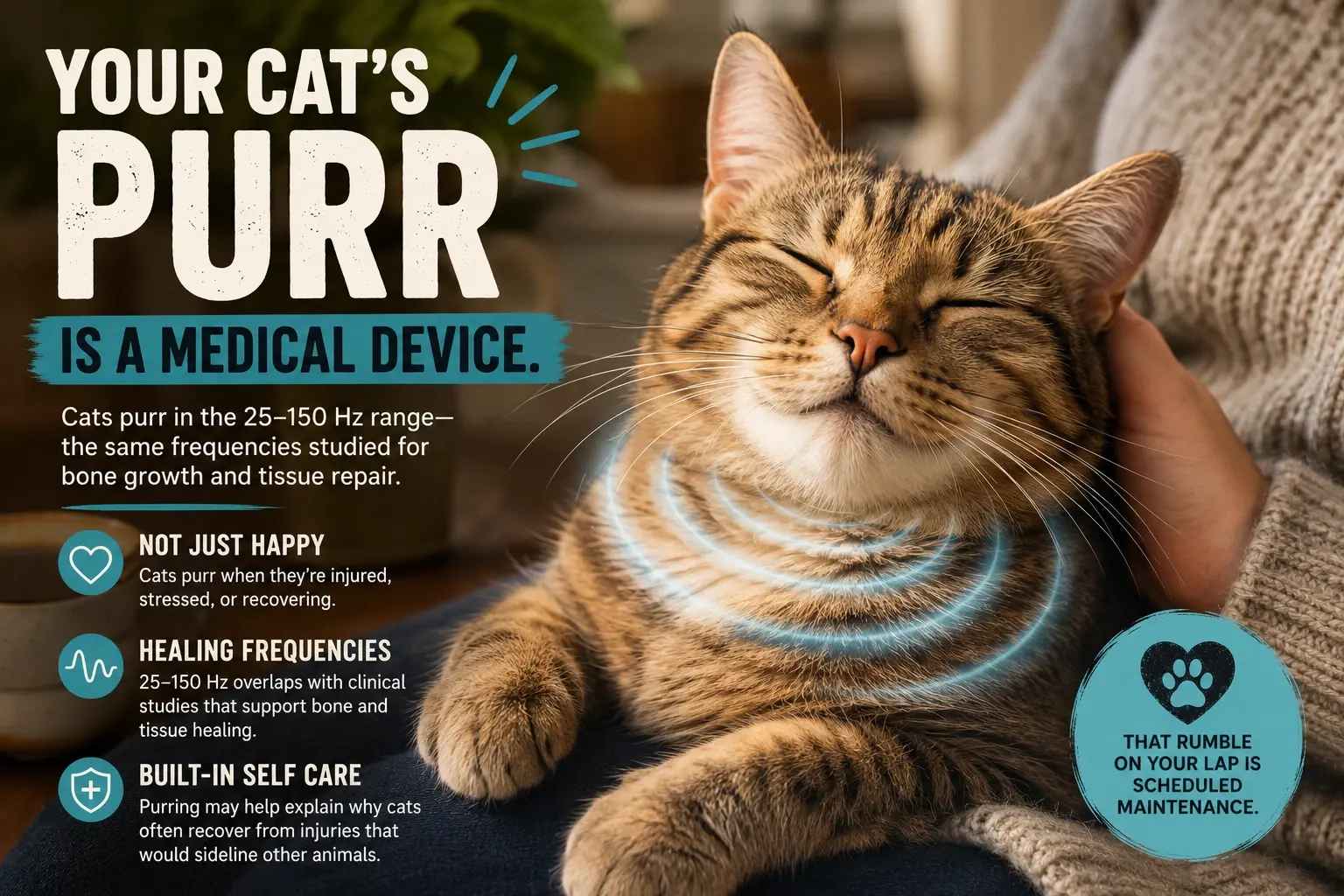
But cats also purr when they want something. Cats with certain illnesses have been observed purring more than healthy cats. And the low-frequency vibration produced during a purr happens to overlap with frequencies scientists have experimented with for their effects on bone.
Which has given rise to one of the most irresistible claims in cat science:
Your cat’s purr is built-in physical therapy.
Is it true?
Maybe.
But the real story is considerably more interesting than the internet version.
First: your cat is basically vibrating
A purr is not just a sound you hear.
It is a physical vibration produced while a cat breathes in and out.
Recent research on feline larynges found that cats can generate the remarkably low fundamental frequencies associated with purring—roughly 25 to 30 hertz—because of specialized tissue structures in their vocal folds. That is unusually low for an animal the size of a house cat.
In other words, when your cat purrs on your chest, you are not imagining that little motor you can feel through your shirt.
Your cat really is oscillating dozens of times every second.
Which brings us to the weird part.
Scientists also vibrate bones
Researchers have spent decades investigating whether low-magnitude mechanical vibration can influence bones and muscles.
Some of those experiments use frequencies surprisingly close to a cat’s purr.
For example, animal studies have tested 35 Hz vibration and reported improved callus formation, mineralization and fracture healing in rats.
Human research has tested similar frequencies too.
A study of postmenopausal women used vibration at 30 Hz, while other clinical work has investigated whole-body vibration as a possible way to affect bone density, muscle performance or fall risk.
So there really is an overlap.
Cat: rrrrrrrrr.
Laboratory vibration platform: rrrrrrrrr.
This is where the “purring heals bones” story comes from.
But there is a very important catch.
Same frequency does not mean same treatment
Frequency is only one part of a mechanical stimulus.
The intensity matters.
So does duration.
So does where the vibration is applied, how it travels through tissue, and what kind of tissue receives it.
And results from vibration therapy research are decidedly mixed.
That 30 Hz randomized trial in postmenopausal women, for instance, found no significant improvement in bone density or bone structure after a year of low-magnitude whole-body vibration. Other studies have found benefits under different conditions.
So the fact that a cat purrs near a frequency used in some bone research does not demonstrate that purring heals fractures.
Nobody has taken two groups of injured cats, assigned one group to purr and the other to remain dramatically silent, and shown that the purring cats healed faster.
Until somebody does, “built-in physical therapy” remains a very good hypothesis wrapped in an excellent headline.
But cats definitely don’t purr only because they’re happy
This part of the story holds up much better.
Researchers have documented different kinds of purring in different contexts.
Cats can produce a special solicitation purr when asking humans for food. It contains acoustic features that people tend to perceive as more urgent than an ordinary purr.
And purring also appears in cats that are not perfectly well.
A 2025 study comparing healthy cats with cats suffering from inflammatory gastrointestinal or skin disease found that affected cats showed more care-soliciting behaviors—including more purring.
So purring clearly cannot be translated simply as:
HAPPY.
Depending on context, it can be part of social bonding, requesting care, seeking food or communicating another internal state.
Your cat has one noise.
It apparently has several departments.
So could purring be self-soothing?
This is where things become plausible—but still unproven.
If cats purr during states other than contentment, the vibration may conceivably have functions beyond communicating happiness.
It could help calm the animal.
It could reinforce social contact.
It could have physiological effects we have not fully characterized.
And yes, because its frequency overlaps with frequencies studied in mechanical-vibration research, scientists and writers have wondered whether purring might confer some musculoskeletal benefit.
That possibility is fascinating.
It is not yet the same thing as evidence.
“Cats purr at frequencies that can heal bone” is too strong.
“Cat purrs overlap with frequencies investigated for biological effects on bone, making a physical function worth studying” is much closer to what the research actually allows us to say.
Less magical.
Still extremely weird.
What about cats surviving huge falls?
This is the other irresistible piece of the theory.
Cats really can survive falls that sound horrific.
Veterinary studies of feline “high-rise syndrome”—injuries caused by falls from buildings—have reported high survival rates among cats that reach veterinary care. A 2025 study reported an overall survival rate of 87%, while other clinical series have reported survival above 90%.
But connecting that resilience to purring is a leap.
Cats have plenty of other things going for them during a fall: relatively low body mass, remarkable balance, a flexible skeleton and an ability to alter body position while airborne.
There is currently no good evidence that a cat walks away from a nasty fall because it switches on the purr motor afterward.
And if your cat falls from a height, do not assume purring means they are okay. Cats can purr while unwell, and serious internal injuries may not be obvious. A significant fall warrants prompt veterinary advice.
The strangest thing about the purr may be how little we still know
For something humans have had vibrating on their laps for thousands of years, the purr remains surprisingly mysterious.
Scientists are still working out exactly how cats produce it.
We know it occurs at unusually low frequencies.
We know cats use it in more situations than simple contentment.
And we know that some frequencies in the same general neighborhood have produced biological effects in experiments involving mechanical vibration.
What we don’t know is whether evolution turned the purr into a feline bone-repair system.
Maybe someday research will show that the vibration really does provide cats with some kind of physiological maintenance.
For now, the medically responsible conclusion is slightly less spectacular:
Your cat is not a licensed physical therapist.
But there is a legitimate scientific mystery humming away in their throat.
And the next time that little engine starts up on your lap, you can appreciate it for what it definitely is:
an extraordinarily strange piece of mammalian engineering.
Maybe contentment.
Maybe communication.
Maybe self-soothing.
Maybe something else science hasn’t figured out yet.
Rrrrrrrrrrrrrrrr.
Scheduled maintenance?
Jury’s still out.